

No granularity
Cloud billing shows what you spent on Bedrock or Azure OpenAI. It does not show which team, which application, or which developer drove it.

AI spend is driven by tokens, GPUs, inference profiles, and coding agents. PointFive helps engineering teams understand what's driving AI spend, identify and quantify waste across every layer of the stack, and enforce the controls needed to scale AI adoption responsibly.
Cloud billing shows what you spent on Bedrock or Azure OpenAI. It does not show which team, which application, or which developer drove it.
Coding-agent tool calls often return more output than the task needs. Every token in that output gets charged. The waste happens automatically, regardless of how good the engineer or the model is.
Most teams have no way to set model policies, cap spend by team, or enforce which tools coding agents can access. Governance is manual at best.
Token management is probably one of the most critical pieces of the overall AI landscape because that is where you tend to blow your budget the fastest.
One platform across cloud AI services, gateways and observability, developer endpoints, and the data platform. Every layer feeds the same cost model.
Managed LLMs, model serving platforms, GPU infrastructure, and data platform AI services.
LiteLLM, Langfuse, and compatible gateway, tracing, and observability platforms.
AI coding agents on employee workstations.
Model serving inside the data warehouse, where AI workloads live next to the data.
Four specific differentiators built for AI workload economics, not generic cloud cost reporting.
Go beyond infrastructure costs to identify waste inside prompts, tool definitions, cache usage, and agent workflows.
Tokenomics is the unit of AI cost. Measure and optimize token consumption across models, applications, prompts, and coding agents.
Allocate spend at the deployment, application, team, prompt, and developer level with a granularity native cloud billing cannot provide.
Normalize spend across AWS, Azure, GCP, Snowflake, Databricks, OpenAI, Anthropic, and the AI coding agents on employee workstations into a single view.
Measure AI efficiency by task outcomes, not token counts alone. Results depend on the workload, the model and caching behavior.
Identify where AI resources and coding-agent context are being wasted.
Help people work better with their AI agents, with guidance on prompts, context and cache habits.
Evaluate model selection and infrastructure sizing against workload requirements.
From cloud AI services and GPU infrastructure to coding agents and prompts.
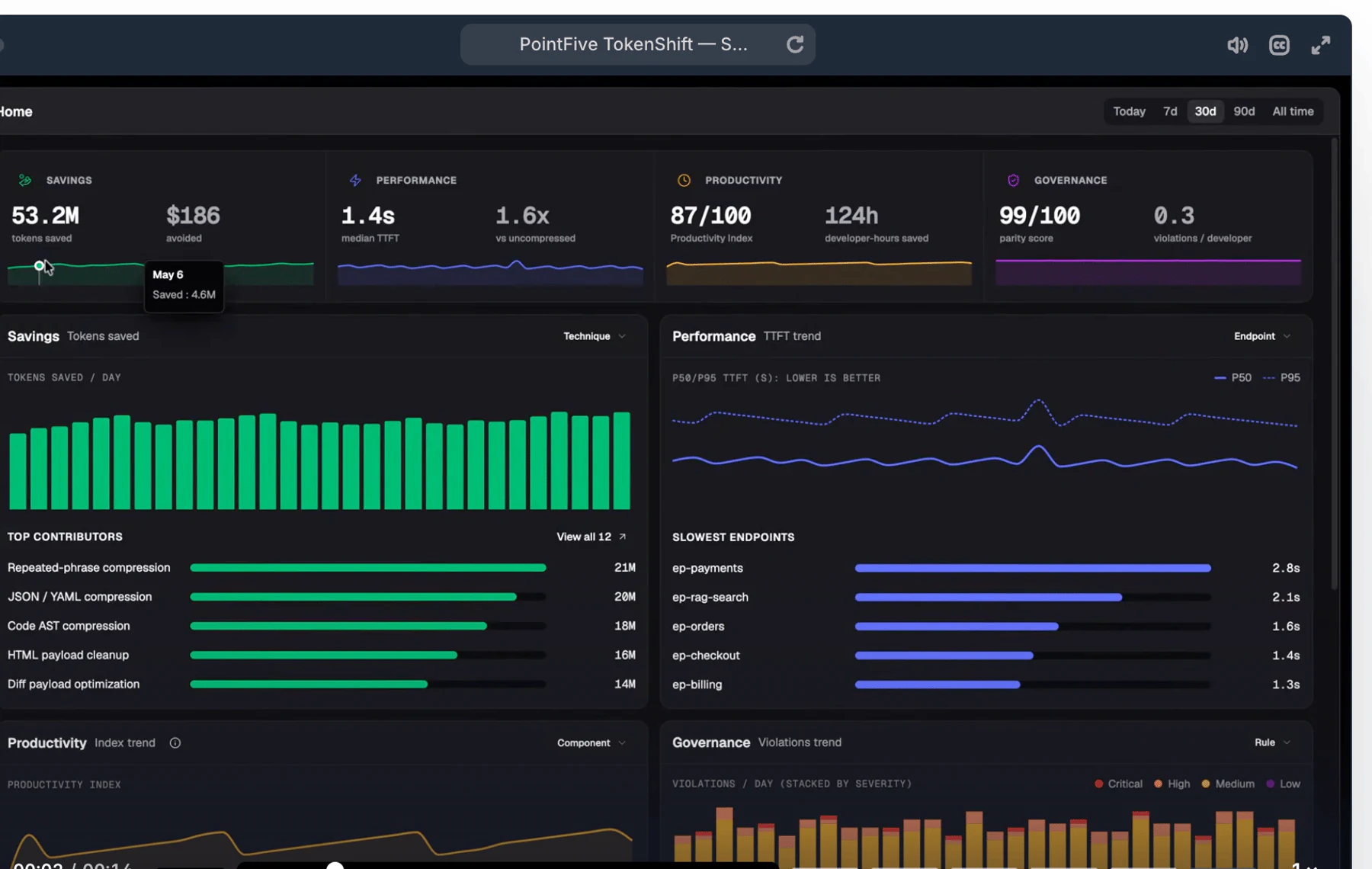
AI cost optimization is the practice of measuring, attributing, and reducing the cost of running AI workloads across the full stack: managed LLM APIs (Azure OpenAI, Amazon Bedrock, Gemini Enterprise Agent Platform (formerly Vertex AI)), GPU infrastructure, inference endpoints, data-platform model serving, and coding agents on developer machines. It goes beyond traditional cloud cost management by addressing token-based billing, prompt and tool-call waste, and AI agents on employee workstations that cloud billing never sees.
Start with the levers your provider already offers: prompt caching for repeated context and batch processing for work that can wait, both documented by OpenAI, Anthropic, Amazon Bedrock, Microsoft Foundry and Google. Then match the model to the task, cap output length and trim the context each request sends. Route traffic through a gateway to set budgets per team, and choose between provisioned throughput and pay-as-you-go from measured utilization. Track cost per completed task, not cost per token. PointFive OS finds this waste across Azure OpenAI, Amazon Bedrock, Gemini Enterprise Agent Platform and GPU infrastructure, and TokenShift governs the AI agents employees run on their workstations.
It depends on where the spend sits. For API traffic, a gateway such as LiteLLM or Portkey, or a router such as OpenRouter, sets budgets and routes requests, and observability tools such as Langfuse or Helicone show cost per request. For AI spend across cloud AI services, GPUs and data platforms, PointFive OS attributes the cost to teams and finds the waste next to the rest of your cloud and data bill. For the coding agents and other AI agents employees run on their workstations, TokenShift by PointFive shows spend by developer and team and enforces model policies and budgets. Most companies combine a gateway with a platform view.
Traditional cloud cost management focuses on compute, storage, and networking with predictable pricing models. AI workloads introduce fundamentally different economics: token-based billing, provisioned-throughput vs. pay-as-you-go decisions, model-version efficiency differences, prompt-cache mechanics, and costs that scale non-linearly with usage. AI cost optimization requires understanding these mechanics at the deployment, prompt, and developer level, not just the billing account level.
PointFive connects to AWS, Azure, Google Cloud, and OCI through agentless, read-only integrations and normalizes spend across providers into a single view. It also covers data-platform AI (Databricks Model Serving, Snowflake Cortex AI), LLM gateways and observability (LiteLLM, Langfuse), and AI coding agents on employee workstations via TokenShift, so engineering leaders can see one number for AI spend regardless of where the workload runs.
Yes. PointFive automatically maps AI spend to teams, applications, prompts, and developers using your existing infrastructure topology and identity signals, so teams get real-time visibility into their AI footprint without manual tagging or spreadsheet reconciliation.
Savings depend on your environment and the changes you implement. PointFive OS finds and prioritizes waste in AI infrastructure and services; measure realized savings against billing after changes. TokenShift does not promise savings: it gives attribution, budget control and better habits for the AI agents on employee workstations.
Connection, data ingestion, and initial recommendations are separate onboarding milestones. Timing depends on your environment and data availability. Realized savings are measured after changes are implemented.
PointFive supports managed LLM services including Azure OpenAI in Microsoft Foundry (GPT-5 family models, including GPT-5.6 and GPT-5.5), Amazon Bedrock (Claude, Amazon Nova, Titan (legacy), Llama, Mistral), and Gemini Enterprise Agent Platform (Gemini, custom models). It also covers GPU infrastructure (including NVIDIA H100, H200, and B300 instances) across AWS, Azure, and GCP, AI training pipelines, inference endpoints, data-platform AI (Databricks Model Serving, Snowflake Cortex AI), LLM gateways (LiteLLM, Langfuse), and the AI coding agents employees run on their workstations (Claude Code, Codex, Cursor, GitHub Copilot CLI, OpenCode, and Devin) via TokenShift.
Yes. PointFive integrates with Jira, ServiceNow, Slack, and Microsoft Teams for workflow management. Opportunities can be pushed directly into your ticketing system with full context, and Slack integration supports real-time alerts, Coworker reports, and team notifications. The PointFive MCP server brings cost intelligence into Claude, Cursor, ChatGPT, VS Code, and other MCP-compatible tools, so engineers can investigate cost questions and act on optimization opportunities without leaving their workflow.