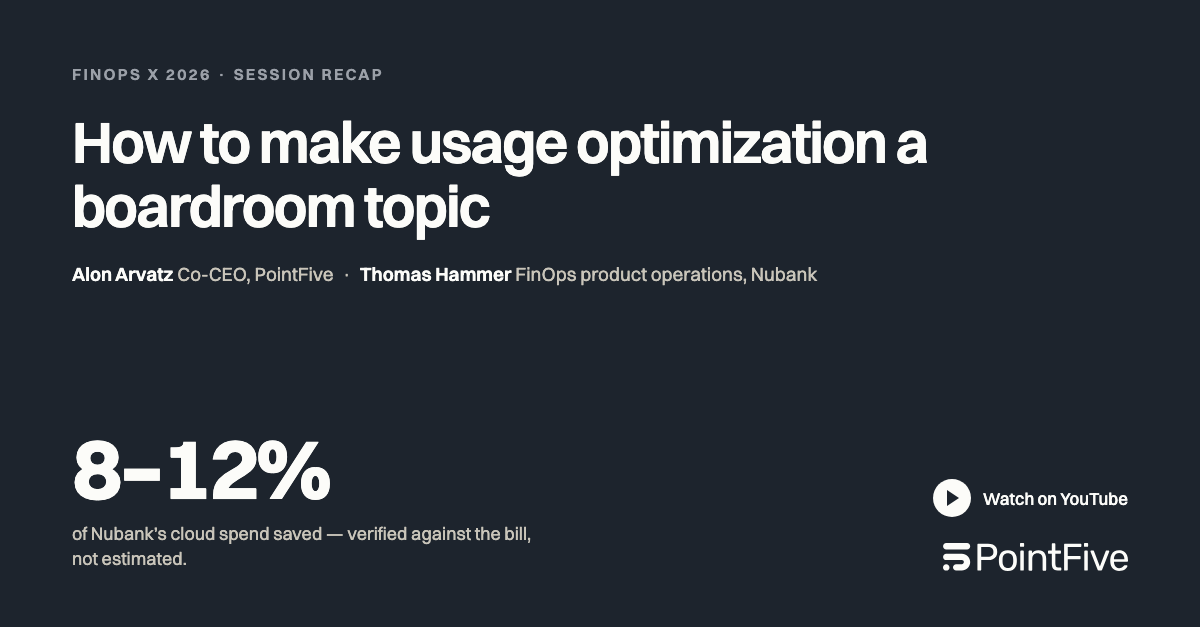
Doing usage optimization is one job. Making executives and the board care about it is another, and it's the one most teams skip. That was the premise when Nubank's Thomas Hammer, who leads product operations for FinOps at one of the world's largest digital financial services platforms, joined PointFive co-founder and CEO Alon Arvatz on stage at FinOps X.
Correction, September 23, 2026: this post previously gave the January-versus-December example as a $60,000 difference; eleven months at $5,000 a month is $55,000.
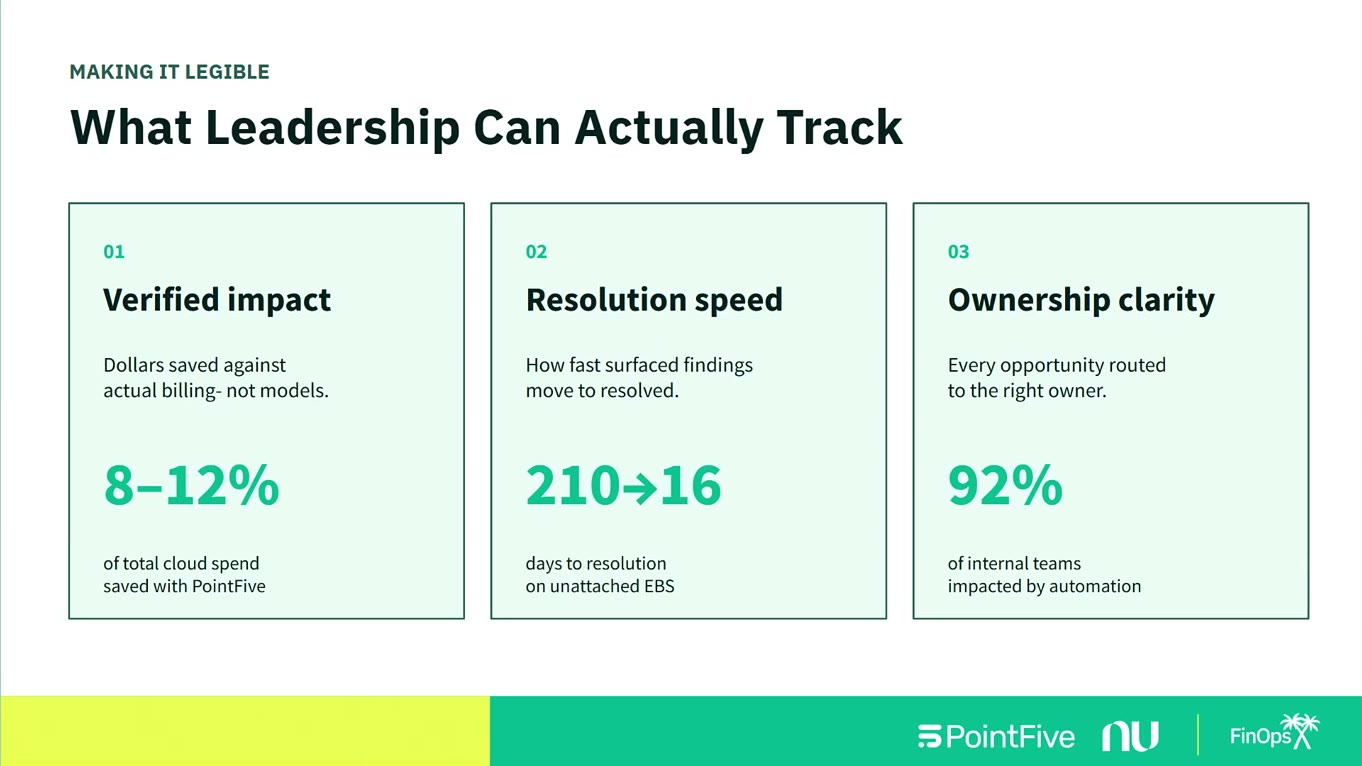
The numbers Nubank put on the screen:
Every number above is measured against actual billing, not modeled. That distinction is the whole talk. The full 47-minute session, from the FinOps Foundation's YouTube channel, is right here, followed by the three moments worth stealing, with links straight to each one.
Estimates get discounted. Verified numbers don't.
Tell a CFO you saved "more or less $500K" and the number shrinks in their head before you finish the sentence: maybe it's $200K, maybe $300K. Alon's rule: accurate, verified savings get roughly twice the credit of an estimate, because there's nothing to argue with.
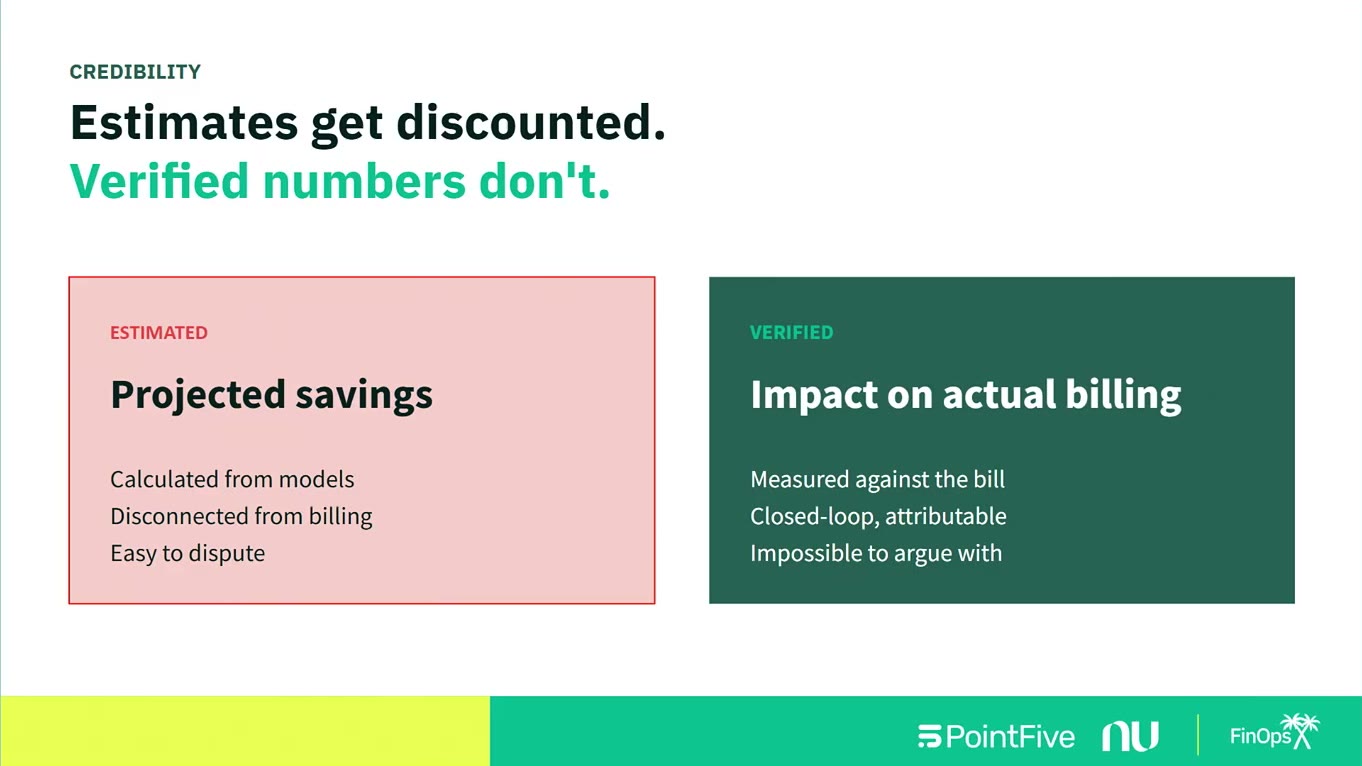
That accuracy is expensive to produce, and that's the point. PointFive's research team splits its time 50/50: half on the detection logic for each inefficiency, half on the formula that calculates what fixing it actually saved (commitments, discounts, changing rates included). Thomas called the shift away from defending models "one of the single biggest changes" in how Nubank's cost conversations go, whether the person across the table is the CFO, the CEO, or the CTO.
The $10 ticket problem
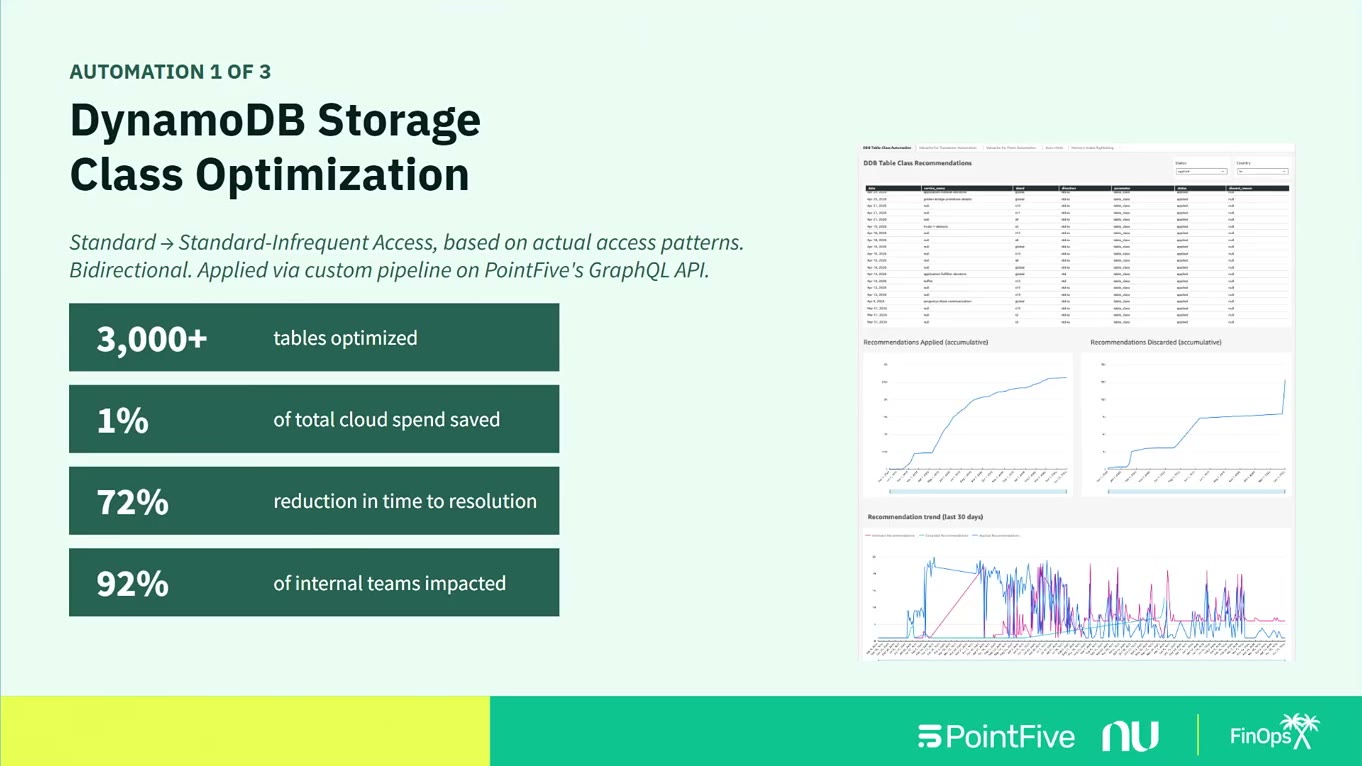
Nobody asks an engineer to fix a ticket that saves $10 a month. Nubank had thousands of them: DynamoDB tables whose storage class no longer matched their access patterns. Each one trivial. In aggregate, not trivial at all.
So the central platform team stopped filing tickets and built an automation on PointFive's GraphQL API. It optimized 3,000 individual tables, and that one opportunity type, in one AWS service, saved 1% of Nubank's total cloud spend. Time to resolution dropped 72%, and 92% of business units were impacted without any of their engineers touching a thing. The follow-on lifecycle automation flipped the responsibility model to opt-out: owners are told before an idle table is archived, and silence means the platform team proceeds.
The same story is told in detail in the Nubank DynamoDB case study.
January versus December is a $55,000 difference
The metric Nubank's CTO actually tracks isn't savings; it's how long an opportunity sits before someone acts. The average unattached EBS volume at Nubank lived 210 days. The automation cut that to 16.
Alon made the cost of waiting concrete: take a $5,000-a-month volume you eventually clean up. Do it in January and you bank the savings all year. Do it in December and you've paid for eleven months of nothing, a $55,000 difference on a single resource. Time to resolution is a bottom-line number, and it belongs in the same slide as the savings total.
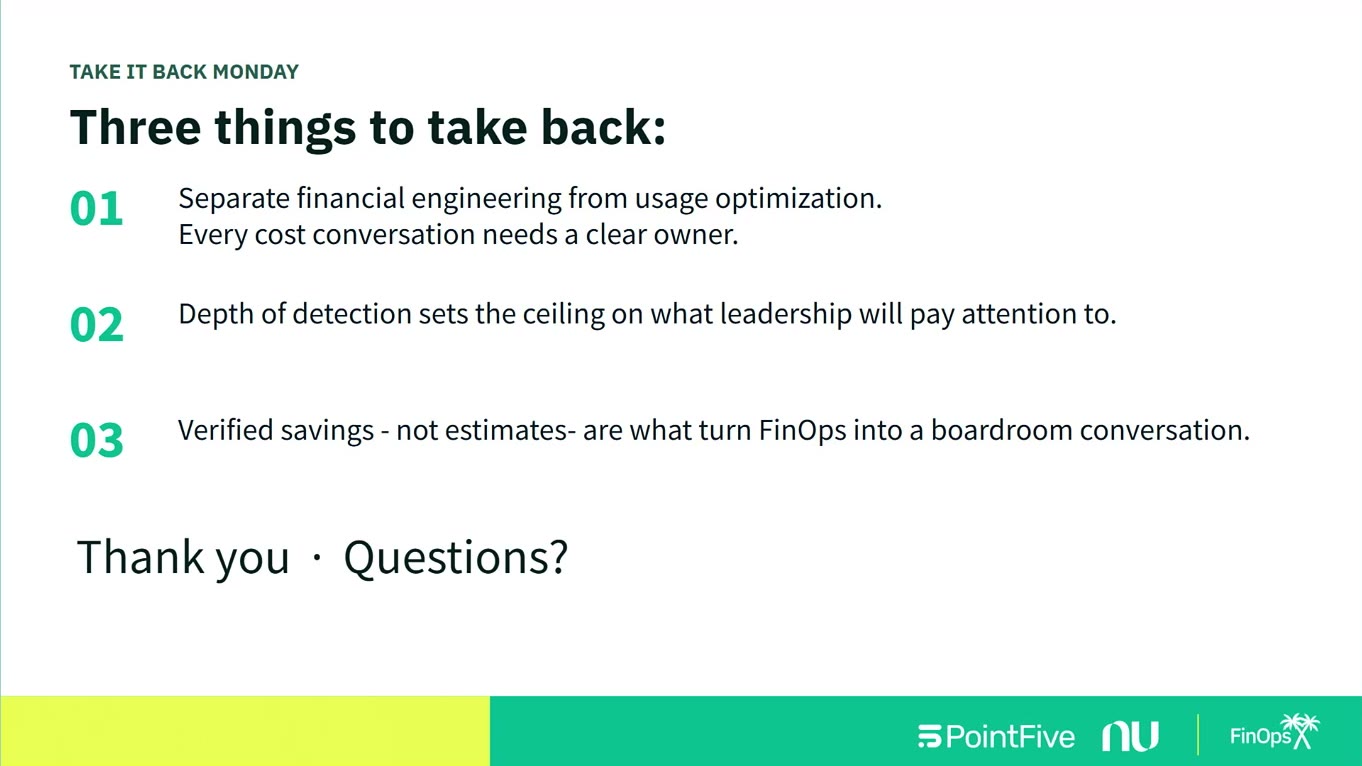
Three things to take back
Thomas closed with the checklist he wished he'd had when Nubank started:
- Separate financial engineering from usage optimization. Rate cards and commitments belong to finance; efficiency-driven usage belongs to engineering. Every cost conversation needs exactly one owner.
- Depth of detection sets the ceiling. The obvious waste (idle and underutilized compute) is already handled in most organizations. The opportunities that earn leadership attention live deeper: configuration drift, application-driven waste, architectural inefficiency.
- Verified savings, not estimates, turn efficiency into a boardroom conversation. When everyone trusts the numbers, everyone can prioritize with them.
Watch the full session on the FinOps Foundation's YouTube channel, and while you're there, subscribe to their channel; the FinOps X session library is worth your time.
For more on how Nubank runs efficiency as an engineering discipline across 45+ business units, read the companion case study. And if you want findings your executives won't discount, see PointFive on your own infrastructure.