

PointFive now supports Oracle Cloud Infrastructure (OCI) cost visibility, giving multi-cloud teams the same dashboard, filters, and anomaly detection they already use for AWS, Azure, and GCP.
Coverage update, September 17, 2026: OCI supports optimization recommendations and approved automated remediation alongside cost visibility and anomaly detection. Remediation uses customer-authorized write access. The current capability descriptions below reflect this update.
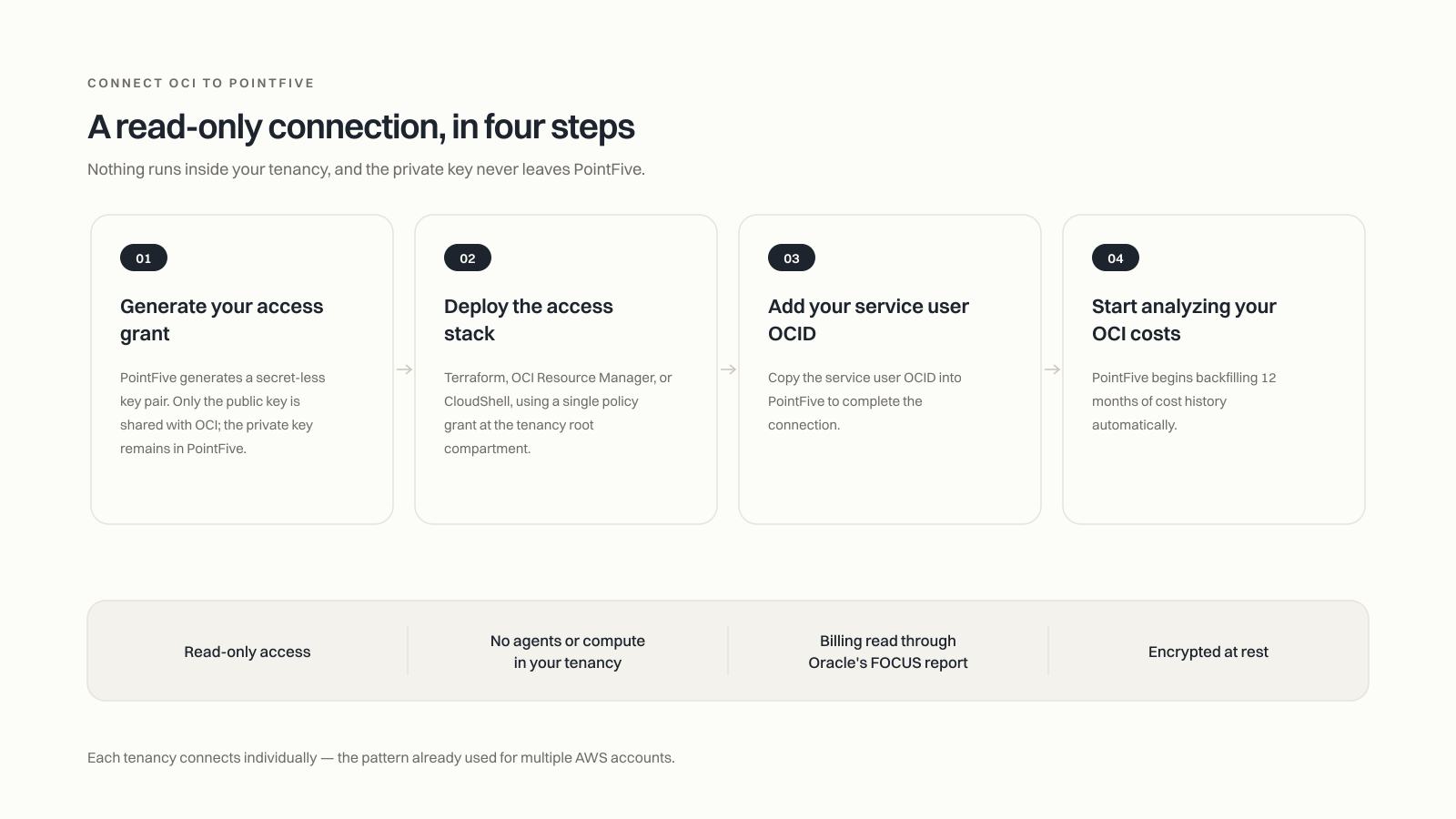
Correction, September 23, 2026: the connection section and diagram previously described the OCI key pair as "secret-less"; the private key is a credential that PointFive holds.
OCI cost shouldn't live in a separate view
If your team runs OCI alongside other clouds, understanding total cloud spend often means looking in two places: OCI Cost Analysis for Oracle spend, and your existing FinOps tooling for everything else. That makes it harder to see where spend is changing and manage costs consistently across providers.
OCI now joins AWS, Azure, and GCP in PointFive's multi-cloud cost view.
What can you see with PointFive's OCI integration?
See OCI alongside your other clouds. OCI cost now sits alongside AWS, Azure, and GCP, giving multi-cloud teams one place to analyze spend across providers.
Analyze spend the way OCI is organized. Group and filter by tenancy, compartment, service, region, or charge type. PointFive treats OCI compartments as a first-class dimension, including nested compartment structures.
Understand how you're paying. Separate Universal Credits from pay-as-you-go spend and analyze costs across up to 12 months of backfilled history.
Monitor for unexpected spend. OCI is included in PointFive's automated daily anomaly detection and appears alongside other providers on the unified Anomalies page.
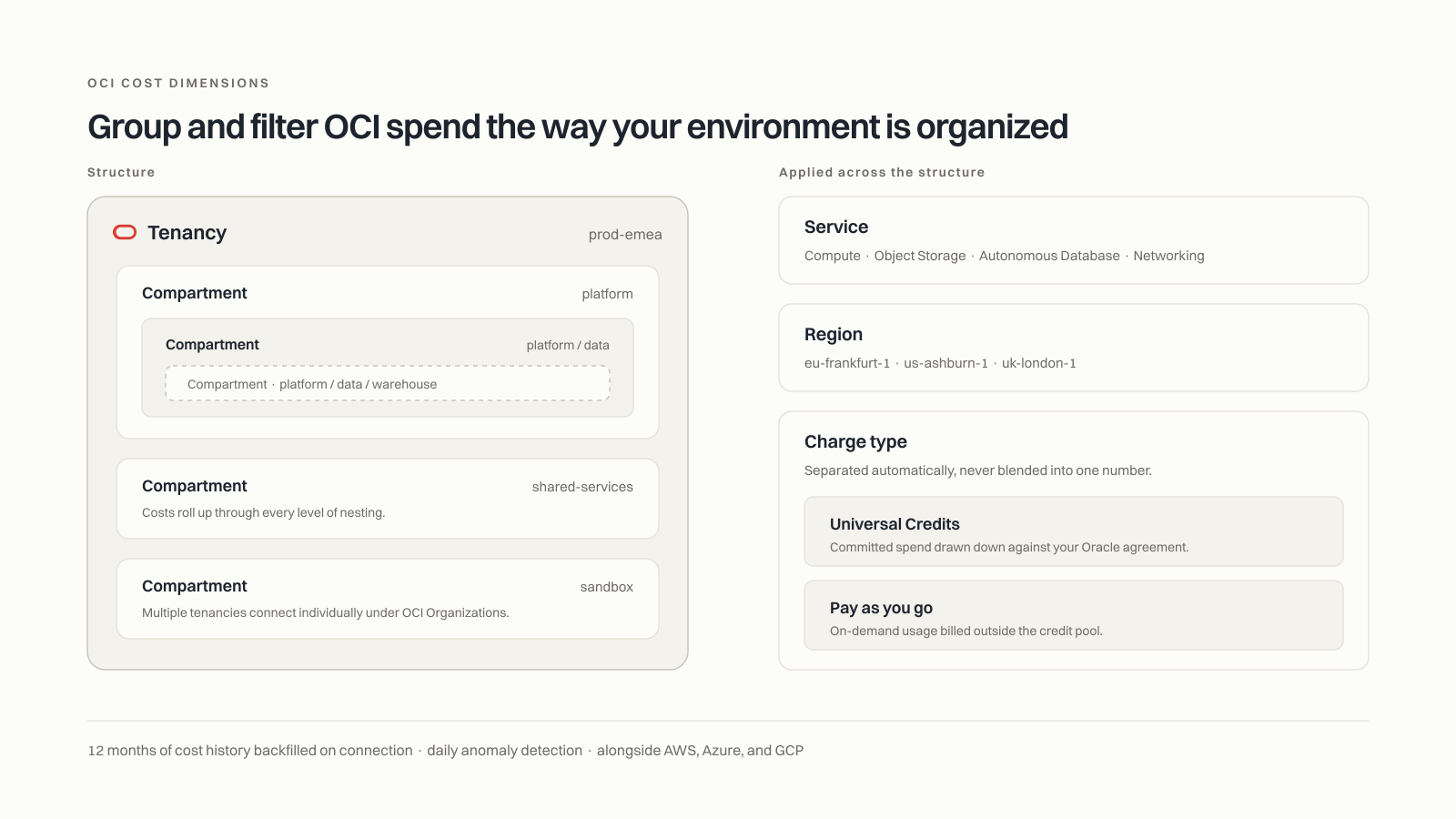
If you run more than one OCI tenancy, PointFive supports OCI Organizations from day one. Each tenancy connects individually, the pattern already used for connecting multiple AWS accounts.
How the connection works
For discovery, PointFive connects to OCI through a read-only service user that authenticates with an API key pair. PointFive generates the pair and shares only the public key with OCI; the private key is a credential that stays with PointFive. You deploy the access stack through Terraform, OCI Resource Manager, or CloudShell using a single policy grant at the tenancy root compartment, then paste the service user OCID into PointFive. Billing data is read through Oracle's FOCUS report. Nothing runs inside your tenancy: no compute, no agents, no persistent footprint.
Does PointFive optimize OCI costs?
Yes. PointFive OS supports OCI cost visibility, anomaly detection, optimization recommendations, and approved automated remediation. Remediation requires approval and customer-authorized write access. You can analyze spend, investigate unexpected changes, and review opportunities to improve OCI cost efficiency.
Frequently asked questions
Does PointFive support Oracle Cloud Infrastructure (OCI)?
Yes. PointFive OS supports OCI cost visibility, anomaly detection, optimization recommendations, and approved automated remediation. Remediation requires approval and customer-authorized write access. OCI costs are available alongside AWS, Azure, and GCP in the multi-cloud view.
Can I manage OCI costs alongside AWS, Azure, and GCP?
Yes. OCI sits in PointFive's multi-cloud cost view, so you can group and compare spend across every provider without switching tools.
Does PointFive support OCI Organizations and multiple tenancies?
Yes, from day one. Each tenancy connects individually, the pattern already used for multiple AWS accounts.
Does PointFive optimize OCI costs?
Yes. PointFive OS supports OCI cost visibility, anomaly detection, optimization recommendations, and approved automated remediation. Remediation requires approval and customer-authorized write access.
How much OCI cost history is available?
A full 12 months of cost history backfills automatically the moment you connect a tenancy.
Bring OCI into your multi-cloud cost view
Already using PointFive? Contact your PointFive team to connect your OCI tenancy.
Managing OCI alongside AWS, Azure, or GCP? See what the OCI integration covers.