

Correction, September 23, 2026: Kiro became generally available in November 2025, not May 2026 as an earlier version said.
Cloud cost has always been discovered too late. The tooling grew up as a rear-view mirror: dashboards, reports, and chargeback models, all of it looking backward at money that was already spent. That was workable when infrastructure decisions were slow and deliberate, made by a small group of people who thought carefully before provisioning anything.
AI coding agents changed that. An agent provisions an EKS cluster from a single prompt. It stands up an RDS instance while you are still describing what you want. The number of infrastructure decisions made per engineer per day has jumped by an order of magnitude, and most of them happen with no cost context at all.
The agent doesn't know you have idle capacity sitting in another account, or that the pattern it just reached for is quietly costing you thousands somewhere else in the org. That knowledge lives in your cloud bill, and the bill arrives next month, well after the spend is already committed.
The fix is putting cost intelligence where the decision actually gets made: in the IDE, in the agent's context, at the moment the code is written. That's what the PointFive Power for Kiro does.
What is Kiro's Powers marketplace?
Kiro is AWS's agentic IDE, generally available since November 2025 and the successor to the Amazon Q Developer IDE plugins. It is built for spec-to-code work, where you describe what you want and the agent builds it.
Powers are composable capability modules. Each one connects Kiro's agent to a vendor's live tools and data, installed with a single click from the Powers panel. Datadog, Dynatrace, Stripe, Figma, Postman, and Supabase all ship Powers today, and now PointFive.
What can I ask PointFive inside Kiro?
Once the Power is installed, Kiro's agent can query your live PointFive data in natural language, in the same session where you are writing infrastructure.
Fourteen tools across four domains:
- Cost optimization. Search and filter opportunities, pull detail on any one of them, aggregate savings by project, service, type, or time period, and retrieve remediation scripts by opportunity group.
- Cloud resources. Search resources with cost and savings filters, aggregate by service or project, inspect a single resource, trace its connections, and surface the opportunities tied to it.
- Anomaly detection. List and filter cost anomalies, get detail on any one, and run contributor analysis to find the root cause.
- Commitment management. Search Savings Plan and Reserved Instance recommendations, and pull the detail behind each one.
In practice, that looks like asking:
- "What are my top cost optimization opportunities in AWS this month?"
- "Show me cost anomalies from the last 7 days, grouped by service."
- "Which Kubernetes workloads have the largest savings potential?"
- "Recommend a Savings Plan strategy for my current EC2 usage."
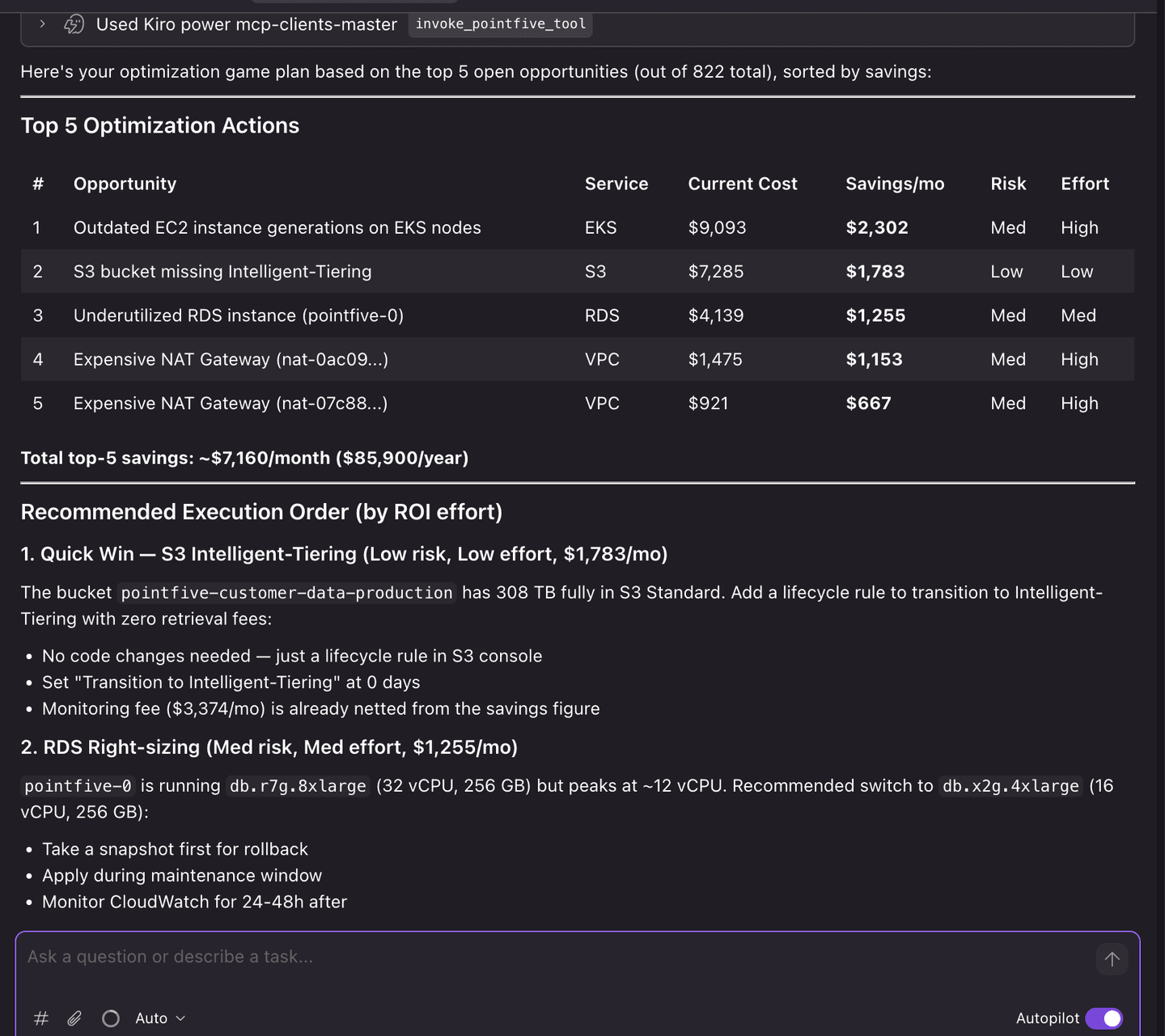
The answers come back from production data, in the editor, while the work is happening, not from a report someone reads two weeks later.
Is my PointFive data secure inside Kiro?
The Power connects to mcp.pointfive.co, our production MCP server, not a sandbox or demo endpoint. It's generally available and already serving customers. There is no new endpoint, no new account, and no new auth flow to stand up.
Permissions mirror your existing PointFive RBAC exactly. The Power can only see what your platform user is already authorized to see, and every call is attributed to that user in PointFive's audit logs. Access is outbound HTTPS only. Nothing connects inbound to your environment.
The architecture is the same pattern AWS points to for Datadog and Dynatrace: a hosted MCP server reached over direct HTTP with a bearer token.
What's actually detecting the savings?
PointFive OS powers the infrastructure investigation behind this interface. It uses hundreds of detection types across AWS, Azure, GCP, and Kubernetes, continuously finding waste that generic cost tooling misses, then prioritizing what it finds by savings potential and remediation effort, and measuring the impact of implemented changes against actual usage and billing.
That's the depth this Power exposes inside Kiro.
How do I install the PointFive Power for Kiro?
If you already use PointFive, installation takes about a minute:
- Generate an API token from your Profile page in the PointFive platform, under API tokens.
- Set it as
POINTFIVE_API_TOKENin the environment Kiro launches with. - Install the PointFive Power from Kiro's Powers panel.
Then start a new Kiro chat and ask a question about your cloud spend.
Full setup instructions are in our help center (customer login required).
What this means for your team
PointFive optimizes every layer, from cloud infrastructure to the coding agent.
That has been our position for a while. With the Power live in Kiro, it is something you can install.
Your agent is going to keep building fast. Now it knows what that costs.
Get started
Already using PointFive? Install the Power from Kiro's Powers panel. Your data is already there.
New to PointFive? Book a demo and we will walk your environment end to end. PointFive is also available on AWS Marketplace, so you can procure against existing AWS commitments.