.png)


Tel Aviv, February 27th, 2026- PointFive today announced DeepWaste™ AI, a standalone, full-stack AI cost optimization module designed to continuously optimize LLM services, GPU infrastructure, and AI data platforms across every major cloud provider.
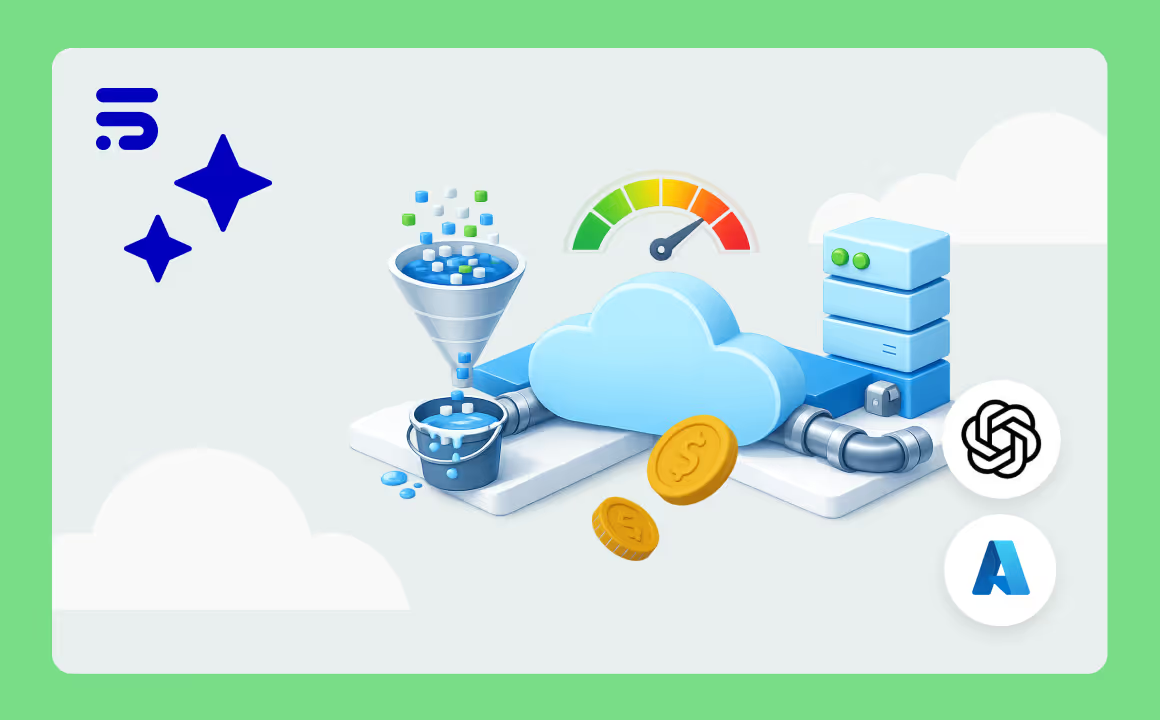
As AI adoption scales from experimentation to production, inefficiency no longer lives in a single layer. Model selection, token consumption, routing logic, caching behavior, GPU utilization, retry patterns, and data platform orchestration all shape AI cost and performance.
Traditional cloud optimization tools were not built to analyze this AI-specific execution stack. DeepWaste™ AI was.
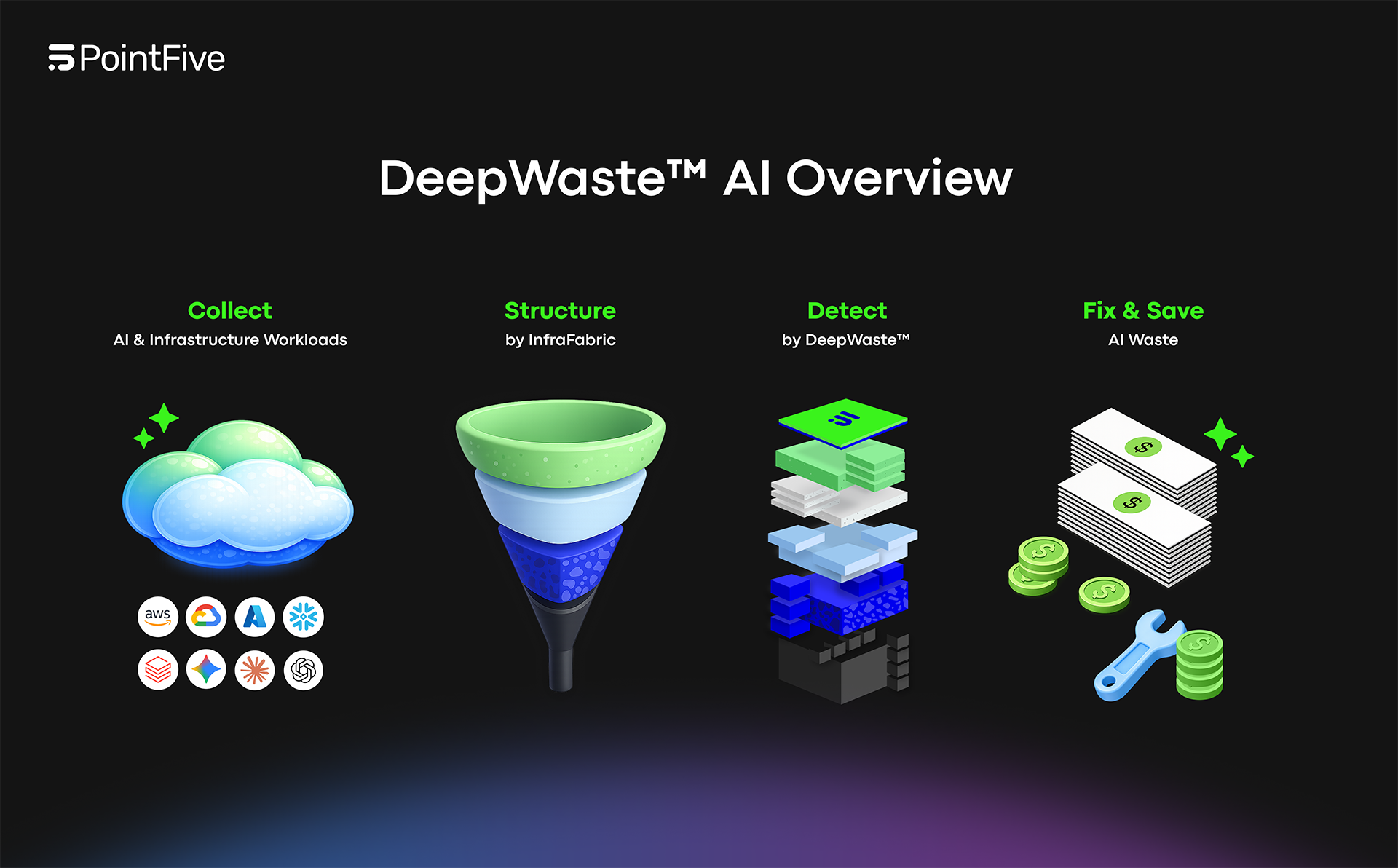
DeepWaste AI provides native, agentless connectivity across:
Beyond LLM services, DeepWaste AI continuously optimizes GPU infrastructure by identifying underutilized or idle GPUs, instance-type mismatches, OS and driver misconfigurations, and hardware-to-workload misalignment.
With native support for Snowflake and Databricks, DeepWaste AI extends optimization across AI data platforms, completing end-to-end coverage from data ingestion through inference.
This is not inference-only visibility. It is full-stack AI optimization.
Agentless by Design, Built for Privacy
DeepWaste AI connects directly to cloud APIs, LLM service metrics, GPU telemetry, and billing systems, without agents, instrumentation, or code changes.
By default, optimization runs using metadata, billing signals, performance metrics, and resource configuration data, without requiring access to raw inference logs.
This enables organizations to uncover structural inefficiencies in model routing, token allocation, caching behavior, retry loops, and infrastructure provisioning while preserving customer privacy and minimizing data access requirements.
For organizations that choose to go deeper, optional inference-level analysis can be enabled to evaluate prompt architecture and orchestration logic.
Customers control the depth of analysis. Optimization adapts accordingly.
Multi-Layer Detection Across the AI Execution Stack
DeepWaste AI structures and enriches every invocation with task classification, routing context, cost attribution, and infrastructure alignment signals.
It detects inefficiency across four core layers:
Each detection is grounded in unified workload signals, not surface-level billing anomalies.
The result is a precise, behavioral understanding of how AI services operate and where efficiency can be improved.
DeepWaste AI does not stop at identifying inefficiencies. Every finding includes a quantified savings estimate and clear implementation guidance.
Recommendations are prioritized by financial impact and mapped directly to engineering and FinOps workflows. Teams can evaluate projected savings before acting and track realized improvements over time.
This transforms AI efficiency from reactive cost monitoring into a continuous, measurable discipline across models, infrastructure, and data platforms.
As AI adoption accelerates, cost visibility alone is insufficient. Efficiency requires understanding how LLM services, GPU infrastructure, and AI data platforms interact, and continuously aligning execution behavior with business value.
DeepWaste™ AI provides:
“AI workloads introduce a new category of operational complexity,” said Alon Arvatz, CEO of PointFive. “DeepWaste™ AI gives organizations the intelligence required to scale AI efficiently- across models, infrastructure, and data platforms, without sacrificing control.”
DeepWaste™ AI is now available to PointFive customers.
%20-1.png)
PointFive pioneered Cloud Efficiency Posture Management (CEPM), redefining how enterprises continuously optimize cloud, infrastructure, and AI environments. By combining a real-time cloud and AI data fabric with AI-driven detection and guided remediation, PointFive transforms efficiency from a reporting exercise into an operational discipline. Customers achieve sustained improvements in cost, performance, reliability, and engineering accountability, at scale.
To learn more, book a demo.